Commencing Your Petition with Wudhu
Translation
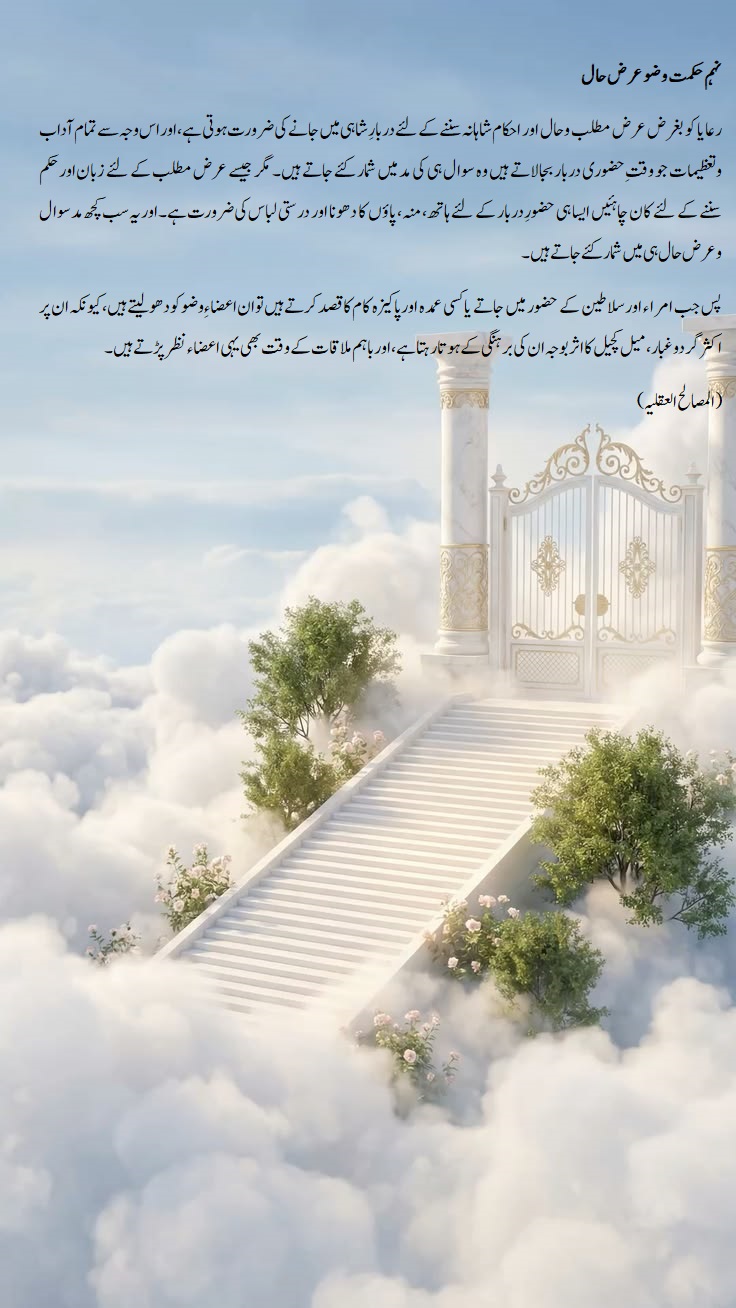
Title: The Ninth Wisdom of Ablution (Wudhu) is Presenting One’s Petition (Arz-e-Haal)
Text:
“Subjects need to go to the royal court to present their petitions and circumstances, and to hear the royal decrees. And for this reason, all the etiquettes and displays of reverence that are observed at the time of attendance in the court are considered part of the very act of petitioning.
However, just as a tongue is needed to present a petition and ears are needed to hear a command, similarly, for being present in the court, it is necessary to wash the hands, face, and feet, and to straighten/clean one’s clothing. And all of these things are also considered part of the very petition and presentation of one’s state.
For when subjects go into the presence of rulers and kings, or intend to undertake a noble and pure task, they wash these limbs of Wudhu, because these limbs are often affected by dust, dirt, and grime due to being exposed. And at the time of meeting, these are the very limbs that are seen (by others).”
(Al-Masaalihul ‘Aqliyyah)
Detailed Explanation: The Courtly Analogy for the Divine Presence
In this ninth wisdom, Hakimul-Ummat, Maulana Ashraf Ali Thanwi (Rahmatullahi alayh), employs a powerful analogy from everyday human experience to make the necessity and wisdom of Wudhu profoundly relatable. He compares the act of approaching Allah Ta’ala in Prayer to the act of a subject approaching an earthly king or ruler.
- The Core Analogy: Earthly Courts vs. The Divine Court
Imagine you have an urgent matter to present to a powerful king, or you have been summoned to hear an important royal decree.
- You would not barge in carelessly. You would observe strict protocols.
- You would not appear unkempt. You would clean yourself, straighten your clothes, and present yourself with utmost respect.
- Your very act of cleaning and preparing is not separate from your petition. It is an integral part of showing that you value the audience and respect the king.
Hazrat Thanwi argues: If this is the case for an earthly king—a mortal who himself is in need of Allah—then how much more so for Allah, the King of all kings, the Lord of the Worlds?
- The Components of the Petition (Arz-e-Haal)
The wisdom breaks down the act of standing before Allah Subhaanahu Wa Ta’ala in Salaah into two parallel needs:
| Purpose in the Royal Court | Required Faculty/Limb | Parallel in Prayer (Salaah) |
| To present your petition (needs, hopes, fears, gratitude) | Tongue (for speaking) | Your tongue recites the Qur’an, makes Thikr, and supplicates (Du’a) |
| To hear the royal decree (command, guidance) | Ears (for listening) | Your ears hear the recitation of the Qur’an and the words of Allah |
| To be present and seen in the court with respect | Face, hands, feet, and clean clothing | These very limbs must be purified through Wudhu |
The deep insight here is that the purification of these limbs is not an “extra” or a “preliminary.” It is as much a part of the petition as the words on your tongue and the listening of your ears. It is the silent, physical component of your submission.
- Why These Specific Limbs? The Wisdom of Exposure
Hazrat Thanwi (Rahmatullahi alayh) then provides a beautiful, practical rationale: why wash the hands, face, and feet specifically?
- These are the limbs most exposed to the elements. Throughout your day, your hands touch everything. Your face is constantly exposed to dust, air, and grime. Your feet (or the footwear covering them) tread on the ground.
- They naturally accumulate the “dust” of worldly activity. This is both literal dust and a metaphor for the spiritual grime of heedlessness and minor sins committed by these limbs.
- In a meeting, these are the limbs that are seen. When you stand before someone in a formal meeting, they see your face, your hands (especially if you gesture), and your feet. These are the visible markers of your state of cleanliness and respect.
Therefore, Allah Ta’ala, in His infinite wisdom, commanded the purification of precisely those limbs that are most in need of frequent cleansing and that are most visible in the posture of standing before Him.
- The Ultimate Conclusion: Wudhu is Part of the Very Petition
The most powerful takeaway from this wisdom is the final sentence:
“And all of these things are also considered part of the very petition and presentation of one’s state.”
This means:
- When you wash your face for Wudhu, you are silently saying: “O Allah, I present this face before You, purified from the dust of the world and the shame of my sins.”
- When you wash your hands, you are saying: “O Allah, I raise these hands to You, cleansed from the wrongs they have committed.”
- When you wash your feet, you are saying: “O Allah, I stand before You on these feet, washed from the paths they have walked towards disobedience.”
Your Wudhu is your Arz-e-Haal (presentation of your state). It is not a ticket to get into the Prayer. It is the first, most essential, physical act of the Prayer itself—the act of presenting yourself, your whole being, in a state of cleanliness and humility before the Lord Most High.
Bottom Line for the Believer
The next time you feel lazy about making Wudhu, remind yourself:
“I am about to stand before the King of kings. If I would clean myself for a meeting with a mayor, a boss, or a respected elder, how can I not clean myself for Allah? My washing of my face, hands, and feet is not separate from my Salaah—it is the very presentation of my petition. It is the physical language of my humility and neediness before Him. Every drop of water is a word in my silent prayer of preparation.”
May Allah Ta’ala grant us the understanding to approach His Court with the reverence it deserves, and may He accept our Wudhu and our Salaah as one complete, beautiful act of submission. Aameen.
(Khairun Nisa)