
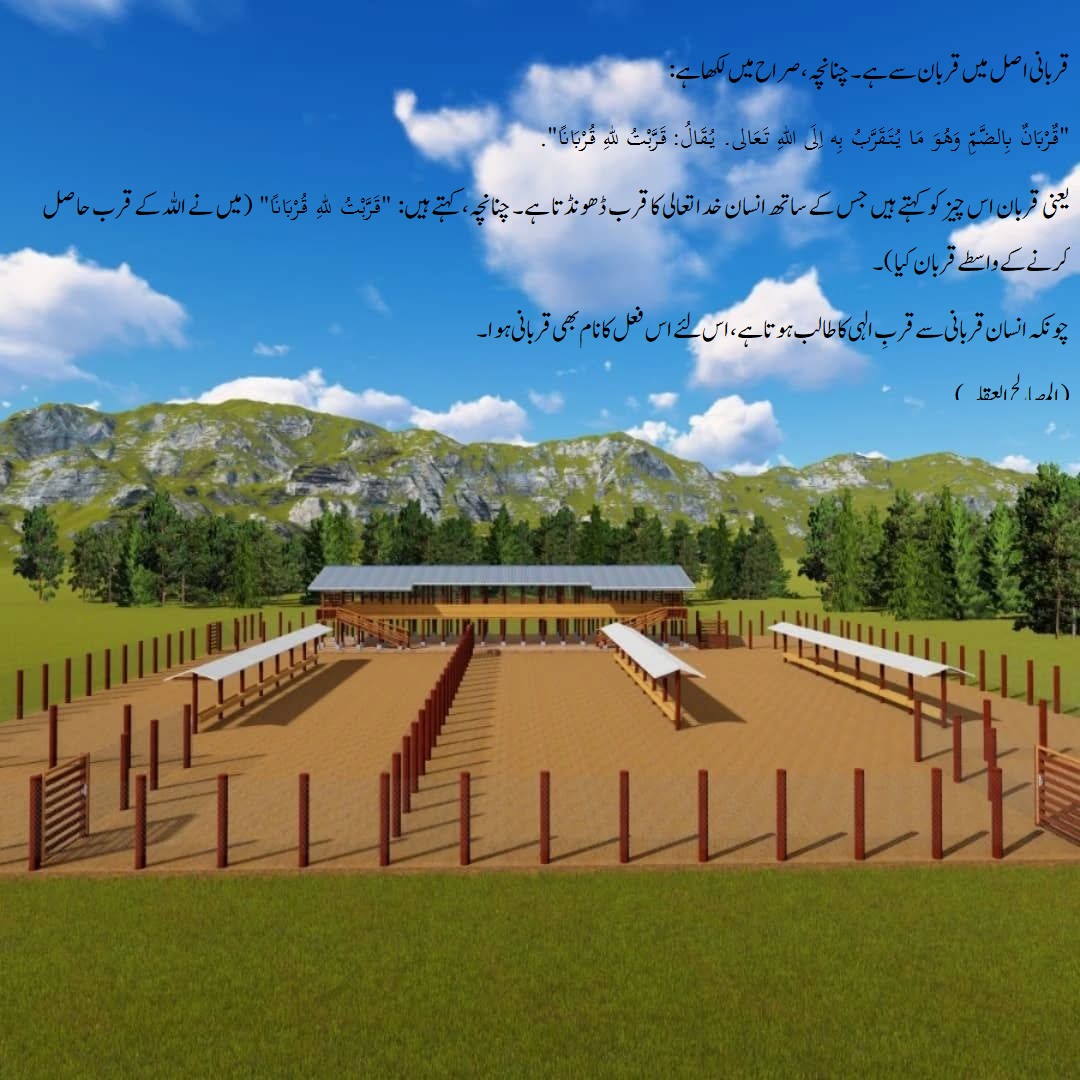
QURBAANI
Translation of the Text
Title: Chapter on Al-Udh-hiyyah (The Sacrificial Animal)
Text:
“The word Qurbaani (sacrifice) is originally derived from Qurbaan. As it is written in Suraah:
‘Qurbaanun (with a dhamma on the Qawf) – it refers to that by means of which one seeks closeness (Taqarrub) to Allah, the Exalted. It is said: “Qarrabtu Lillaahi Qurbaanan” (I have offered a sacrifice to Allah to seek closeness).’
That is, Qurbaan is the term for that thing through which a person seeks the closeness of Allah, the Exalted. Thus, it is said: ‘Qarrabtu lillaahi qurbaanan’ (I sacrificed for the sake of attaining closeness to Allah).
Since, through sacrifice, a human being seeks the closeness of Allah, therefore, this act itself is also named Qurbaani.”
(Al-Masaalihul ‘Aqliyyah)
Detailed Explanation: The Linguistic and Spiritual Heart of Sacrifice
In this opening passage of the chapter on Al-Udh-hiyyah (the sacrificial animal offered on Eidul-Adh-ha), Hakimul-Ummat, Maulana Ashraf Ali Thanwi (Rahmatullahi alayh), does something profound. He does not begin with the rules (Masaail) of sacrifice. Instead, he begins with its linguistic root because, in the tradition of Islam, words carry the essence of meaning. By understanding the origin of the word Qurbaani, we understand the spiritual purpose of the entire act.
- The Linguistic Root: From Qurbaan to Qurbaani
- Qurbaan (قربان): This is the root noun. It comes from the Arabic letters Qawf-Raw-Baa (ق-ر-ب), which carry the core meaning of “closeness, nearness, proximity.”
- Taqarrub (تقرب): This is the verbal noun meaning “the act of seeking closeness.”
- Qarrabtu (قربت): This means “I brought close” or “I offered as a means of closeness.”
Therefore, a Qurbaan is literally “that which is offered as a means to draw near.” It is not primarily about slaughtering an animal. It is about using that animal as a vehicle, a medium, a bridge to traverse the distance between the servant and the Lord.
- The Core Spiritual Objective: Seeking Divine Closeness (Qurb-e-Ilaahi)
Hazrat Thanwi states this with absolute clarity:
“Since, through sacrifice, a human being seeks the closeness of Allah, therefore, this act itself is also named Qurbaani.”
This means:
- The goal is Qurb (closeness to Allah).
- The means (the wasilah) is the animal offered in sacrifice.
- The name of the entire act is derived from the goal, not the means.
This is a critical shift in perspective. Often, people think of Qurbaani as “killing an animal for meat to distribute to the poor.” While that is one outcome, it is not the essence. The essence is spiritual elevation and divine proximity.
- The Two Dimensions of Sacrifice
| Dimension | Physical/Outward (Zaahiri) | Spiritual/Inward (Baatini) |
| What is offered? | An animal (sheep, goat, cow, camel) | One’s own ego, desires, attachments |
| What is slaughtered? | The throat of the animal | The base self (An-Nafsul-Ammara) |
| What flows? | Blood | The love of the world |
| What is gained? | Meat distributed | Divine closeness (Qurb) |
| Symbolism | Obedience to Allah’s command (as with Ibrahim Alayhis Salaam) | Submission of the self entirely to Allah Azza Wa Jall |
The great Sufi masters have always taught that the ultimate Qurbaan is not an animal. The ultimate Qurbaan is one’s ego.
When Nabi Ibrahim (Alayhis Salaam) was commanded to sacrifice his son, Ismail (Alayhis Salaam), it was a test of whether he would sacrifice what was most beloved to him for Allah. When he passed that test, Allah replaced Ismail (Alayhis Salaam) with a ram. That ram was a symbol that the true sacrifice had already occurred in Nabi Ibrahim’s heart—the sacrifice of his own will, his own desires, his own attachments.
- Continuity with the Wisdoms of Wudhu
This chapter on Qurbaani is a natural continuation of the earlier discussion on Wudhu. In both cases, Hazrat Thanwi (Rahmatullahi alayh) is demonstrating the same principle:
- Wudhu: Physical purification (washing limbs) leads to spiritual purification (removal of negligence, angelic proximity, divine audience).
- Qurbaani: Physical sacrifice (slaughtering an animal) leads to spiritual sacrifice (subduing the ego, attaining divine closeness).
Both are outward acts prescribed by the Shariah that serve as vehicles for inward transformation. Neither is a mere ritual. Each is a doorway to Qurb-e-Ilaahi.
- The Practical Lesson for the Believer
When you intend to perform Qurbaani on Eidul-Adh-ha, let this understanding transform your intention:
Before the sacrifice:
- Remind yourself: “I am not just buying an animal to slaughter. I am seeking a means to draw closer to Allah.”
- Reflect: “What is the ‘Ismail’ in my life? What is the thing I love most that Allah is asking me to submit? My wealth? My status? My comfort? My opinions?”
- Intend: “O Allah, just as I physically sacrifice this animal, I spiritually sacrifice my ego, my desires, and my attachments to anything other than You.”
During the sacrifice:
- Do not see it as merely a mechanical act. See it as a symbolic enactment of your own submission.
- Understand that the blood that flows is a reminder that your own base desires must be “slaughtered” at the threshold of Allah’s command.
After the sacrifice:
- Know that the meat distributed to family, neighbours, and the poor is not the purpose. It is the blessing and outcome of having achieved the true purpose—closeness to Allah.
- A person who attains Qurb-e-Ilaahi will naturally be generous, compassionate, and caring for others.
A Timeless Reminder
Nabiyyuna Muhammad (Sallallahu Alayhi Wasallam) said:
“The son of Aadam does not perform any deed on the Day of Nahr (Sacrifice) that is more beloved to Allah than shedding blood (of the sacrificial animal). And verily, it will come on the Day of Resurrection with its horns, its hair, and its hooves (as a witness for the one who offered it). And indeed, the blood is accepted by Allah before it even falls to the ground. So let your soul take pleasure in it.” (Sunanut-Tirmithi, Ibn Maajah)
Notice the Hadith does not say: “The meat is beloved to Allah.” It says the act itself—the act of seeking closeness, the act of obedient submission—is beloved. And that act is named, from its very origin, Qurbaan.
May Allah grant us the ability to perform our Qurbaani with this deep understanding, and may He accept it as a means of drawing us closer to His noble presence. Aameen.
(Munsha’ib)