
Wudhu Awakening the Body and Soul
Translation of the Text
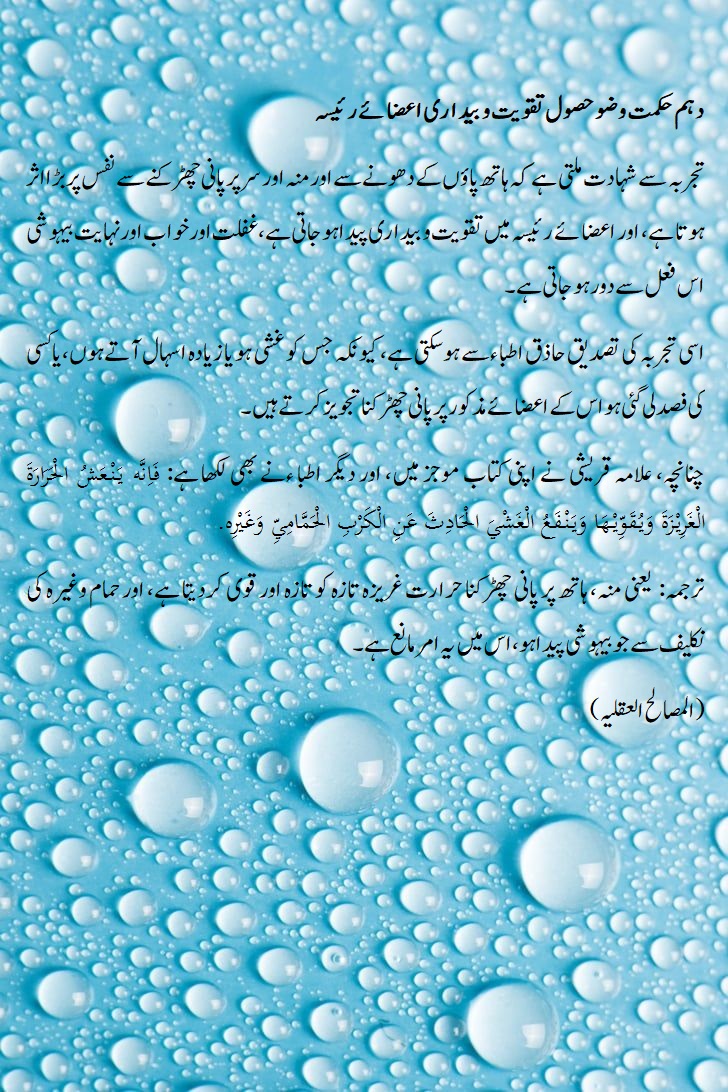
Title: The Tenth Wisdom of Ablution (Wudhu) is the Attainment of Strength and Wakefulness in the Principal Organs
Text:
“Experience bears witness that washing the hands and feet, and sprinkling water on the face and head, has a profound effect upon the self (nafs), and it generates strength and wakefulness in the principal organs. Negligence, sleep, and extreme unconsciousness are removed by this act.
Confirmation of this experience can be obtained from skilled physicians, for they prescribe sprinkling water on these mentioned limbs for someone who has fainted, or has excessive diarrhoea, or has undergone bloodletting (venesection).
Thus, Allaamah Qurashi has written in his book Mujaz, and other physicians have also written:
‘For indeed, sprinkling water on the face and hands revives and strengthens the innate heat (haraarah ghareezah), and it prevents fainting that occurs due to the distress of the bathhouse and other causes.'”
(Al-Masaalihul ‘Aqliyyah)
Detailed Explanation: The Physical-Physiological Wisdom of Wudu
In this tenth wisdom, Hakeemul-Ummat, Maulana Ashraf Ali Thanwi (Rahmatullahi alayh), continues to demonstrate the holistic nature of Islamic law. After discussing the profound spiritual benefits of Wudhu (divine love, angelic proximity, entering the divine symbol), he now turns to its tangible, observable, physical benefits.
This wisdom serves as a bridge, showing that the Shariah is not concerned only with the soul (Rooh) to the exclusion of the body (jism). Rather, it addresses the whole human being.
- The Concept of “Principal Organs” (A’za-e-Ra’eesah)
The term “principal organs” (A’za-e-Ra’eesah) refers to the primary centres of vitality and consciousness in the human body. According to both ancient and modern physiology:
- The Brain: The centre of consciousness, thought, and nervous control.
- The Heart: The centre of circulation, life force, and (in Islamic understanding) spiritual cognition.
- The Nervous System: The network that transmits sensation and commands.
The limbs washed in Wudhu—hands, feet, face, head—are not random. They are the extremities that are richest in nerve endings and most directly connected to these principal organs. By stimulating these extremities with water, you send powerful signals to the brain and nervous system, awakening and energizing the entire body.
- The Physiological Mechanism: Innate Heat (Haraarah Ghareezah)
Hazrat Thanwi cites the medical understanding of his time regarding “innate heat” (haraarah ghareezah). This concept, found in ancient and medieval medicine (Galenic, Unani, and early Islamic medicine), refers to:
- The natural, internal warmth of the body that is essential for life, digestion, metabolism, and vitality.
- This heat is centred in the heart and distributed through the blood.
- When this innate heat is weak, a person experiences lethargy, drowsiness, unconsciousness, or even death.
- When it is strong and balanced, a person is alert, energetic, and healthy.
How does sprinkling water on the face, hands, and head affect this innate heat?
The answer is a combination of:
- Thermal Stimulation: Cool water on the skin causes a reflexive response. Blood vessels initially constrict (pushing blood inward to preserve core heat) and then dilate (increasing circulation). This “shock” revives the body’s natural heat and energy production.
- Nervous Stimulation: The trigeminal nerve (facial nerve) and the numerous nerve endings in the hands and feet are directly stimulated by water. This sends immediate, activating signals to the brainstem and the reticular activating system (RAS)—the part of the brain responsible for wakefulness and alertness.
In simple terms: Cold water on the face and hands acts as a biological “reset” button, waking up the brain and energizing the body.
- Medical Confirmation: Fainting, Diarrhoea, and Bloodletting
Hazrat Thanwi cites the practice of skilled physicians to validate this wisdom. He mentions three specific conditions where physicians prescribe sprinkling water on the face, hands, and feet:
| Condition | Cause | Why Water Helps |
| Fainting (Ghashyah) | Sudden drop in blood flow to the brain, often due to shock, pain, or heat | Water stimulates nerve reflexes that increase heart rate and blood pressure, restoring consciousness |
| Excessive Diarrhoea (Is-haal) | Loss of fluids and electrolytes, leading to weakness and potential collapse | The external stimulation of water helps revive the system while internal rehydration is also needed |
| Bloodletting (Fasd) | Loss of blood volume, leading to weakness and dizziness | Water stimulates circulation and helps the body compensate for the blood loss |
Hazrat Thanwi presents a quote from Allamah Qurashi which specifically mentions fainting that occurs “due to the distress of the bathhouse” —a common phenomenon in traditional bathhouses (hammaams) where excessive heat, steam, and dehydration could cause people to faint. Sprinkling cold water on the face was an immediate remedy.
This is not “ancient superstition.” Modern medicine confirms that diving reflex (cold water on the face triggers bradycardia and peripheral vasoconstriction), cold water stimulation increases alertness and can help revive someone who feels faint, and hydrotherapy is a recognized medical practice.
The Esteemed Status of Allāmah Ibnun-Nafīs Al-Qurashi
Allaamah Ali Ibnun-Nafīs Al-Qurashī, was a towering figure of the 13th century. Born in Damascus in 607 AH (1210 CE), he rose to become one of the most celebrated physicians in the Islamic Golden Age. He was not only a physician but also a polymath proficient in jurisprudence, Arabic literature, logic, and hadith. His reputation was so great that he was appointed as the chief physician in Egypt and the personal physician to the Sultan. His contributions to science are monumental, culminating in him being described by historians as the “Second Ibn Sīnā”.
Perhaps his most famous scientific achievement is his discovery of the pulmonary circulation, or minor blood circulation. In his commentary on Ibn Sīnā’s Canon, he was the first to correctly describe how blood flows from the right ventricle of the heart to the lungs, where it mixes with air before returning to the left ventricle, a discovery that would not be replicated in the West until much later. This revolutionary insight contradicted the centuries-old theories of Galen.
His Book Al-Mujaz fit-Tibb
The book known as Al-Mujaz fit-Tibb (The Summary of Medicine) is the work of Allāmah Ibn al-Nafīs. Recent scholarship has confirmed that it was originally conceived as an independent handbook for students and practitioners of medicine, rather than a simple abridgment of Ibn Sīnā’s Canon as was previously assumed. The book was a highly influential and popular medical text in the medieval and early modern periods .
In the book, Ibnun-Nafīs Al-Qurashi systematically presents the general principles of medicine, including hygiene and therapeutics, and explains diseases, their symptoms, and treatments, covering both dietary and medicinal-based therapies. It also includes an extensive catalogue of materia medica—simple medications and remedies—that is arranged in alphabetical order. This work represents the pinnacle of what was widely accepted in the medical field during a Golden Age of Islamic civilization.
- The Application to Wudhu: Beyond Ritual
If physicians prescribe the treatment of sprinkling water after someone has fainted or become weak, what is the wisdom of Allah Subhaanahu Wa Ta’ala prescribing it before standing in His presence?
The answer is profound:
- Allah Ta’ala knows that when you come to Prayer, you may be in a state of spiritual “fainting” —negligence (Ghaflat), drowsiness, forgetfulness, and disconnection from Him.
- He prescribes Wudhu as a preventative and curative measure. It is the “cold water splash” that revives your spiritual consciousness before you stand before Him.
- Just as water on the face revives the body from physical unconsciousness, it revives the heart from spiritual heedlessness.
Nabi Muhammad (Peace be upon him) alluded to this when he said:
“When any of you sleep, Shaytaan ties three knots at the back of his neck…” (Bukhari).
The remedy? Performing Wudhu, making Thikr and engaging in Salaah, which “undoes” those knots. This is the spiritual equivalent of the physiological awakening described here.
- Synthesis with Previous Wisdoms
This tenth wisdom integrates perfectly with the earlier ones:
| Wisdom | Focus | How it Connects |
| 1st | Abandoning negligence (Ghaflat) | Wudhu removes the “intoxication” of heedlessness |
| 5th | Increase of intellect (‘Aql) | Wudhu sharpens the mental faculty |
| 6th | Return of light and joy (Noor wa Suroor) | Wudhu restores spiritual radiance |
| 10th | Strength and wakefulness in principal organs | Wudhu provides the physical and physiological foundation for all the spiritual benefits |
Without a wakeful body, there can be no wakeful heart. Without a revived nervous system, there can be no sustained concentration (Khushu’) in Salaat. Wudhu addresses the whole person —body, mind, and soul—so that the whole person can stand before Allah.
Practical Lesson for the Believer
If you ever struggle with drowsiness, laziness, or an inability to concentrate in Prayer, remember this tenth wisdom:
- Perform your Wudhu with vigour. Do not merely wet your limbs. Make sure water thoroughly reaches the skin. Feel the sensation. Let it wake you up.
- Pay special attention to the face. Rasulullah ﷺ emphasized washing the face completely in Wudhu. This is the primary “control panel” for alertness.
- If you are extremely drowsy, do not rush. Rasulullah ﷺ said: “If one of you feels drowsy while praying, let him sleep until his drowsiness goes away, because if he prays while drowsy, he may intend to seek forgiveness but end up cursing himself.” (Bukhari). Similarly, refresh your Wudhu.
- See Wudhu as your spiritual “alarm clock.” Every time you make Wudhu, especially for Fajr Salaah, understand that you are physically and physiologically preparing your entire being—not just your soul—to meet Allah.
May Allah Ta’ala grant us wakefulness of body and presence of heart, and may He accept our Wudhu and our Salaah as the worship of whole, conscious, and alert servants. Aameen.
(Khairun Nisa)