
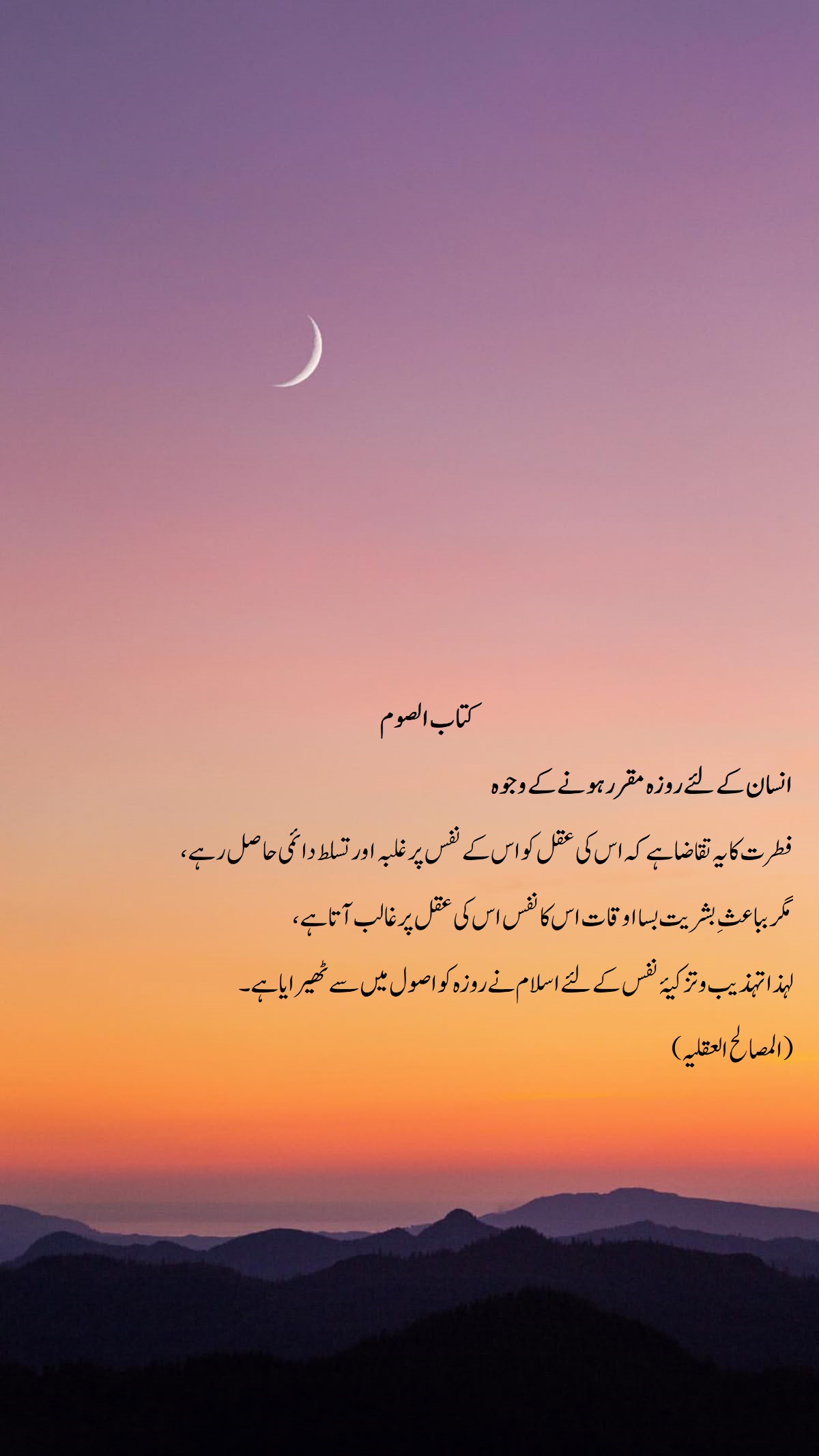
The Book of Fasting
Bismillahir Rahmanir Rahim
Kitaabus Saum (The Book of Fasting)
What a blessed time we find ourselves in! With the crescent of Ramadhaan gracing our horizons, we turn the pages of Al-Masaalihul Aqliyyah. It is an honour to undertake this journey into the wisdom of Saum.
Here is a reflection on the first foundational principle highlighting Saum – Fasting.
The Book of Fasting
The Reasons for the Prescription of Fasting for Mankind
It is a demand of human nature (fitrah) that his intellect should have permanent dominance and sovereignty over his self (nafs). However, due to his humanity (bashariyyat), sometimes his self (nafs) overcomes his intellect. Therefore, for the refinement and purification of the self, Islam has established fasting as one of its fundamental principles.
(From: Al-Masaalihul Aqliyyah)
The Reasons for the Prescription of Fasting for Mankind
This passage cuts directly to the core of the human condition, presenting not just a rule, but a diagnosis and a prescription.
- The Ideal State: The Sovereignty of Intellect (غلبہ اور تسلط دائمی): The text begins by establishing the primordial design (فطرت) of a human being. We are not meant to be slaves to our impulses. The true essence of a human, the crown of our creation, is the faculty of reason (عقل). The ideal state, as envisioned by nature itself, is for this intellect to have permanent dominance and sovereignty over the lower self (نفس). This is the state of a balanced and fulfilled human life, where decisions are made based on principle, wisdom, and long-term good, rather than fleeting desires.
2. The Reality: The Revolt of the Self (بسببِ بشریت):
However, we are not angels; we are human (بشریت). And this humanity comes with an inherent tension. Due to our physical makeup, our emotions, and our worldly attachments, the Nafs (the ego, the base desires) often rebels. It refuses to be governed. It demands immediate gratification. Sometimes, it overwhelms the citadel of the intellect. This internal struggle, this occasional victory of the Nafs over the Aql, is the source of much of our spiritual and moral downfall.
3. The Prescription: Fasting as the Principle of Discipline (روزہ کو اصول میں سے ٹھیرایا):
So, how does one restore the rightful order? How does one train the Nafs to accept the authority of the Aql? Islam, in its infinite wisdom, establishes Fasting (Saum) as a core principle (اصول) for this very purpose.
Fasting is not merely hunger and thirst. It is a practical, intensive training course for the soul.
-
- It weakens the Nafs: By denying it its most basic necessities (food, drink, and marital relations) during daylight, we starve the ego’s rebellion. Its power diminishes when it is not immediately obeyed.
- It strengthens the Aql: When the body is not preoccupied with indulgence, the spirit and intellect have room to breathe. The mind becomes clearer, more attuned to reflection, remembrance, and obedience. The decision to fast is an act of the intellect overruling the body’s demands.
- It establishes Tarbiyah (Training): The word used is تہذیب وتزکیۂ نفس (Refinement and Purification of the Self). This implies a process. A month of fasting is like an annual spiritual drill. It teaches the Nafs patience, discipline, and the habit of submission. By the end of Ramadhaan, the goal is that the intellect, having been reinforced by this training, is better equipped to maintain its leadership for the rest of the year.
In Essence:
This first lesson tells us that Fasting is the divinely ordained mechanism to recalibrate our internal compass. It is the annual overhaul of the soul, designed to ensure that the commanding officer (the Intellect) remains firmly in control of the rebellious soldier (the Self); that the wise Mistress of the House (the Intellect) remains firmly in charge of the unruly child (the Self) who throws tantrums for immediate gratification. It is not a punishment, but a profound mercy—a path to the very dignity and balance that our nature (فطرت) craves.
The goal is not to crush the nafs, but to raise it, discipline it with love, and bring it under the gentle but firm authority of wisdom.
May we all enter this training ground with the intention of reclaiming the sovereignty of our intellect and purifying our Nafs (selves).
Your companion in this quest,
Khairun Nisa