
STANDING BEFORE THE EVER-AWAKE
Last updated on October 12th, 2026 at 05:39 am
Reading Time: 3 minutesTranslation of the Text
Title: The Continuation of the Tenth Wisdom — The Divine Rationale for Wudhu
Text:
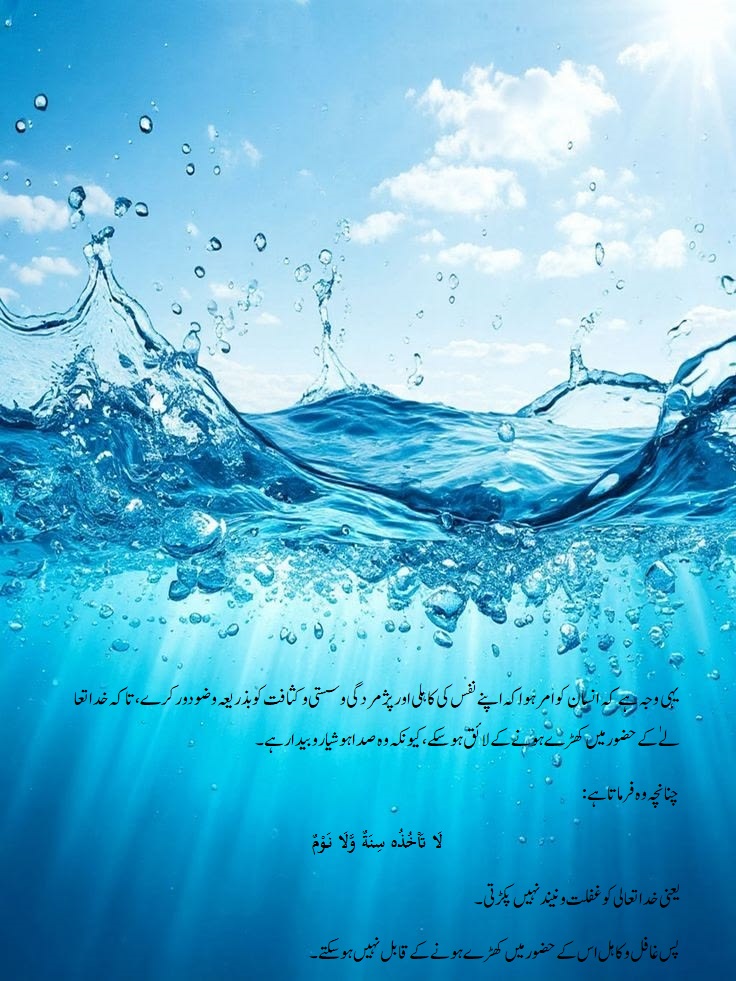
“This very reason is why man has been commanded to remove the laziness, dullness, sluggishness, and heaviness of his self (Nafs) through Wudhu, so that he may become worthy of standing before Allah, the Exalted, because He is All-Aware, Ever-Alert, and Ever-Awake.
Thus, He says: ‘Neither drowsiness nor sleep overtakes Him.’ (Surah Al-Baqarah, 2:255)
That is, Allah, the Exalted, is not overtaken by negligence or sleep.
Therefore, the negligent and the lazy cannot be worthy of standing in His presence.” (Al-Masaalihul ‘Aqliyyah)
Detailed Explanation: Aligning with the Divine Attribute of Perpetual Wakefulness
In this concluding segment of the tenth wisdom, Hakimul-Ummat, Maulana Ashraf Ali Thanwi (Rahmatullahi alayh), elevates the physiological benefits of Wudhu to a profound spiritual and theological principle. He connects the physical act of awakening the body to the very nature of the One we are about to address—Allah, the Ever-Awake, the Ever-Alert.
- The Divine Command: Removing the Heaviness of the Self
Hazrat Thanwi explains that Wudhu is legislated to remove four interrelated negative states of the self (Nafs):
| Term | Meaning | Spiritual Implication |
| Kasāl (كسل) | Laziness, indolence | Reluctance to engage in worship; procrastination in obedience |
| Pazhmurdagī (پژمردگی) | Dullness, lethargy, wilting | A state where the spirit feels withered, lacking vitality and enthusiasm for goodness |
| Sustī (سستی) | Sluggishness, slackness | Physical and spiritual inertia; inability to act with vigour |
| Kasāfat (کثافت) | Heaviness, turbidity, grossness | A thick, dense state of the soul that prevents spiritual perception; the opposite of spiritual refinement (Latāfat) |
These are not merely physical conditions. They are spiritual states that veil the heart from the light of faith and prevent the soul from ascending to its higher potential. Wudhu is prescribed as the cleansing agent for this spiritual heaviness. It washes away the “dirt” of negligence and revitalizes the soul, much as water revitalizes a wilting plant.
- The Divine Attribute: Perpetual Wakefulness (Al-Qayyūm)
Hazrat Thanwi (Rahmatullahi alayh) then cites the most powerful verse in the Qur’aan—Āyatul-Kursī (Surah Al-Baqarah, 2:255):
لَا تَأْخُذُه سِنَةٌ وَّلَا نَوْمٌ
“Neither drowsiness nor sleep overtakes Him.”
This verse describes the ultimate attribute of Allah’s Self-Subsistence (Qayyūmiyyah). It establishes that:
- Allah is perpetually aware. Unlike His creation, He experiences no lapse in consciousness.
- Allah is eternally active. He is not subject to the fatigue, rest, or unconsciousness that humans and all living beings experience.
- Allah is the Ever-Watchful (Ar-Raqīb). His awareness encompasses all things at all times—every thought, every action, every hidden secret.
This divine perfection sets the standard for the servant who wishes to stand before Him.
- The Necessary Alignment: Standing Before the Ever-Awake
Hazrat Thanwi draws the logical conclusion:
“Therefore, the negligent and the lazy cannot be worthy of standing in His presence.”
- If you are standing before a king, you must be attentive and alert. How much more so when standing before the King of kings?
- If you approach Allah—the One who is perpetually wakeful and aware—in a state of spiritual drowsiness, spiritual dullness, or heaviness, you are, in effect, disrespecting His attribute. You are coming to the Ever-Awake as one who is asleep.
- You cannot have a meaningful audience with the Ever-Aware if you yourself are not present, attentive, and alert.
- The Synthesis: Wudhu as the Bridge
This wisdom beautifully synthesizes the physical, physiological, and spiritual aspects of Wudhu:
| Through Wudhu… | Spiritual Outcome… | Ultimate Purpose… |
| Laziness (Kasāl) is removed | The heart becomes active and eager | You stand with enthusiasm and presence before Allah |
| Dullness (Pazhmurdagī) is removed | The spirit becomes refreshed and vital | You stand with vitality and joy before Allah |
| Sluggishness (Sustī) is removed | The soul becomes energetic and swift in obedience | You stand with vigour and readiness before Allah |
| Heaviness (Kasāfat) is removed | The heart becomes refined, light, and perceptive | You stand with clarity and insight before Allah |
When you remove these four states, you become “worthy” of standing before Allah. It is not that Allah becomes “closer” or “farther”—He is always close. Rather, you become able to experience that closeness because the veils of negligence and heaviness have been lifted from your heart.
Practical Reflection for the Believer
Before every Wudhu, and especially before standing for Prayer, remind yourself:
- “I am about to stand before the One who never sleeps, never slumbers, and is ever watchful over all things.”
- “If I come to Him in a state of spiritual drowsiness—yawning, distracted, lazy—I am not honouring the reality of who He is.”
- “Let me use this Wudhu as my spiritual ‘splash of cold water.’ Let it awaken my body, my heart, and my mind. Let it shake off the heaviness of the world, the laziness of my nafs, and the dullness that sin brings.”
- “After Wudhu, I am not just physically clean. I am spiritually awake. I am now ready to stand before the Ever-Awake.”
A Profound Summary
Hazrat Thanwi (Rahmatullahi alayh) leaves us with a powerful principle:
“The servant cannot stand in the presence of the Ever-Awake while the servant is spiritually asleep.”
Wudhu is the divine command that bridges this gap. It is both the physical remedy for bodily lethargy and the spiritual remedy for soulful heedlessness. By performing it with understanding, we align ourselves—even if only for a moment—with the timeless, wakeful, and ever-alert presence of our Lord.
May Allah Ta’ala grant us the ability to stand before Him with wakeful hearts and alert minds, and may He accept our Wudhu and our Salaah as the worship of conscious, present, and attentive servants. Aameen.
(Khairun Nisa)