The Essence of the Eid Sacrifice
Translation of the Text
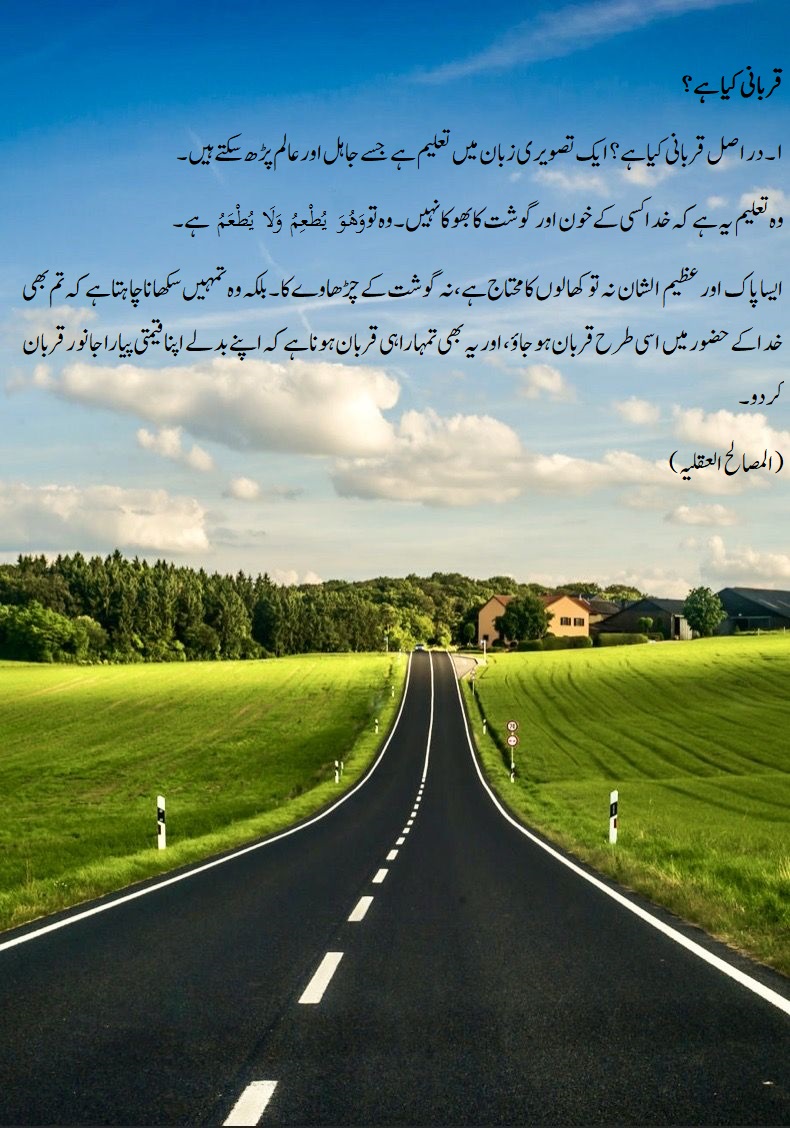
Title: 1. What is Sacrifice (Qurbaani) in Reality?
Text:
“In reality, what is Qurbaani? It is an instruction conveyed in a pictorial language, which both the ignorant and the learned can read.
That instruction is this: Allah is not in need of anyone’s blood or meat. He is such that ‘He feeds and is not fed.’ (Surah Al-An’aam, 6:14)
Such a Pure and Magnificent Being is neither in need of skins nor of the offering of meat. Rather, He wishes to teach you that you too should become sacrificed (Qurbaan) in the presence of Allah, just as this animal is sacrificed. And this act of yours sacrificing your precious, beloved animal on your behalf is itself [a symbol of] you becoming sacrificed.” (Al-Masaalihul ‘Aqliyyah)
Detailed Explanation: The Deeper Reality of Sacrifice
In this profoundly insightful passage, Hakimul-Ummat, Maulana Ashraf Ali Thanwi (Rahmatullahi alayh), cuts through superficial understandings of Qurbaani and reveals its true spiritual essence. He answers the foundational question: What is really happening when a Muslim performs sacrifice on Eidul-Adh-ha?
- A Pictorial Language for All (Taswiri Zabaan)
Hazrat Thanwi begins with a remarkable statement: Qurbaani is “an instruction conveyed in a pictorial language, which both the ignorant and the learned can read.”
- What is a “pictorial language”? It is a language of symbols, actions, and visible rituals rather than words and theoretical explanations. Just as a picture can convey a thousand words, the act of sacrifice conveys deep spiritual truths that even an unlettered person can grasp by witnessing it.
- Why for both ignorant and learned? Because spiritual truths are not limited to intellectual comprehension. A simple believer may not understand complex theological discussions about Qurb-e-Ilaahi, but when they see an animal being sacrificed in the Name of Allah, they instinctively grasp: “Something is being offered. Something precious is being given up. This is about submission.”
- Qurbaani is a living lesson, not a textbook. It is a drama enacted annually, where every Muslim becomes both the actor and the student.
- The Negative Theology: What Allah Does NOT Need
Hazrat Thanwi forcefully negates any primitive or anthropomorphic understanding of sacrifice:
“Allah is not in need of anyone’s blood or meat.”
This directly addresses a potential misunderstanding. In pre-Islamic pagan traditions, offerings were made to idols and ‘gods’ because those false deities were imagined to need sustenance, appeasement, or propitiation. The idolaters would even smear the blood of sacrifices on their idols.
The Qur’aan categorically rejects this:
- “Their meat will not reach Allah, nor will their blood. But what reaches Him is piety (Taqwa) from you.” (Surah Al-Hajj, 22:37)
- “He feeds and is not fed.” (Surah Al-An’aam, 6:14)
Allah is Al-Ghaniyy (The Absolutely Self-Sufficient). He does not eat, drink, or require anything from His creation. He is the Creator and Sustainer of all. If He commands sacrifice, it is not for His benefit but for ours.
- The Positive Theology: What Allah DOES Want
If Allah does not need blood or meat, why command sacrifice? Hazrat Thanwi (Rahmatullahi alayh) answers:
“Rather, He wishes to teach you that you too should become sacrificed (Qurbaan) in the presence of Allah, just as this animal is sacrificed.”
This is the core revelation of the entire chapter. The animal is a mirror. In its sacrifice, you are meant to see your own reflection.
| The Animal | The Human Being |
| Is led to the place of sacrifice | Is led by divine command to the path of submission |
| Is laid down on its side | Must lay down their ego, pride, and resistance |
| Has its throat cut | Must “slaughter” their base desires (Shahawaat) |
| Breathes its last | Must die to the lower self (die before physical death) |
| Bleeds | Must let go of attachments to worldly things |
| Is offered entirely to Allah | Must offer one’s entire being to Allah |
The instruction is clear: You are not just sacrificing an animal. You are, in a symbolic and spiritual sense, sacrificing yourself.
- The Substitution Principle: The Animal on Your Behalf
Hazrat Thanwi then adds a crucial nuance:
“And this act of yours sacrificing your precious, beloved animal on your behalf is itself [a symbol of] you becoming sacrificed.”
- The animal is substituted for you. You are not commanded to sacrifice yourself literally (as some previous nations were tested with human sacrifice). Islam prohibits human sacrifice completely.
- But the animal stands in your place. It represents something precious and beloved to you – your wealth, your property, your attachment to worldly possessions.
- By sacrificing something you value (a healthy animal that you could have kept for milk, breeding, or sale), you are training your soul in the art of letting go for Allah’s sake.
- When you willingly spend money on an animal, then lay it down, and say “Bismillaah, Allaahu Akbar” (In the name of Allah, Allah is the Greatest), you are declaring: “I too am willing to lay down everything I have and everything I am for You, O Allah.”
- The Quranic Confirmation: The Story of Ibrahim and Ismail (Alayhimas Salaam)
This understanding is rooted in the very event that gave rise to Eidul-Adh-ha. When Nabi Ibrahim (Alayhis Salaam) was commanded to sacrifice his son Ismail (Alayhis Salaam), he did not hesitate. He took his beloved son to the place of sacrifice and laid him down.
But after attempting to slaughter, Allah substituted a ram in Ismail’s place. What was the lesson?
- Allah did not need Ismail’s blood. He needed Ibrahim’s willingness to sacrifice his most beloved possession for Allah’s command.
- The ram was accepted on behalf of Ismail. Ismail was, in effect, “sacrificed” symbolically through the ram.
- The true sacrifice had already occurred in Ibrahim’s heart. The physical act was the outward confirmation.
Similarly, when you sacrifice an animal on Eid, you are reenacting Ibrahim’s (Alayhis Salaam) submission. Your animal is your “Ismail.” Your willingness to sacrifice something precious is your “Ibrahim.”
Practical Lessons for the Believer
Before, during, and after your Qurbaani, internalize these lessons:
- Before Qurbaani: Ask yourself honestly — “What is the most difficult thing for me to give up for Allah? My comfort? My reputation? My time? My wealth? My ego?” The animal you sacrifice represents that thing. Choose your animal with love and care. Pay for it from your beloved wealth. Let it be precious to you.
- During Qurbaani: When you lay the animal down, imagine laying down your own ego. When you recite “Bismillaah, Allaahu Akbar” and make the cut, intend in your heart: “O Allah, I slaughter my greed, my arrogance, my laziness, and my attachment to this world at Your command.”
- After Qurbaani: Do not forget the lesson. The meat is distributed and eaten, but the spiritual state of being sacrificed to Allah should remain with you throughout the year. Just as the animal’s life was offered entirely to Allah, your life — your actions, your words, your intentions — should be offered entirely to His pleasure.
A Beautiful Summary
Hazrat Thanwi (Rahmatullahi alayh) concludes this teaching by implication: Qurbaani is a madrasah for the soul. Its curriculum is Taslim (submission). Its textbook is a living animal. Its language is action. Its exam is the slaughter. Its grade is Qurb-e-Ilahi (Divine Closeness).
May Allah enable us to read this pictorial language correctly and to become among those who are truly sacrificed to His will — not just one day a year, but every day of our lives. Aameen.
(Munsha’ib)